
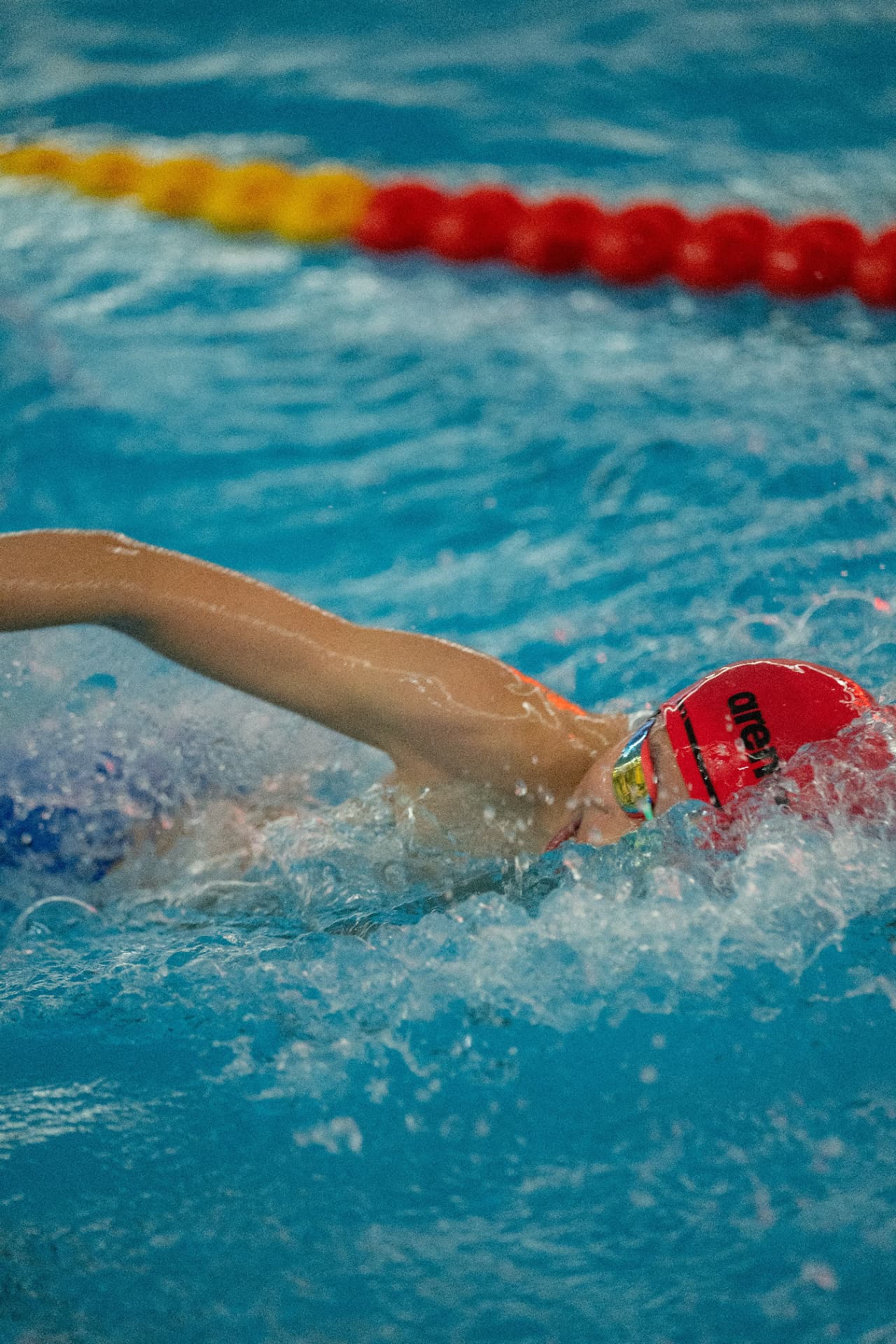
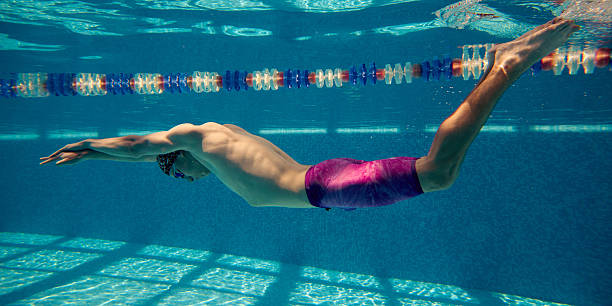
Body position and alignment·Phase: Whole stroke
Body Line & Head Position
Research-supportedA neutral head and level body keep the swimmer's cross-section small. Lifting the head tends to drop the hips and legs.
Biomechanical principle
Form drag increases with the frontal area the body presents to the water. A see-saw effect links head height to hip height.
Why it matters
Lower drag means the same propulsion produces more speed, and less effort is spent holding the legs up.
Proper execution
- Eyes look down and slightly forward
- Back of the head roughly in line with the spine
- Light core engagement to keep hips up
- Kick stays within the body's shadow
Observable improvement
- Hips visible near the surface from deck
- Water line sits around the crown of the head
- Less kick effort needed to stay level
Common mistakes & corrections
| Fault | Corrective strategy |
|---|---|
| Looking forward with the head lifted | Cue eyes to the bottom; use a snorkel or kick-on-side work to feel the level line. |
| Sagging hips and dragging legs | Develop a steady, compact kick and core engagement; check head position first. |
Coaching cues
“Eyes down, hips up”“Long and tall in the water”“Swim downhill”
Supporting references
- Toussaint HM, Beek PJ. Biomechanics of competitive front crawl swimming. Sports Medicine. 1992;13(1):8–24.
- Maglischo EW. Swimming Fastest. Champaign, IL: Human Kinetics; 2003.
- USA Swimming — Technique and coaching education resources.