Resource Builder
Build a Resource
Choose a stroke, focus and level, pick the technical components and sections, reorder them, then save, print or export as a PDF. All content comes from the verified EST Stroke Lab library.
Preview

Stroke Mechanics Guide · Freestyle · Developmental
Freestyle Stroke Mechanics Guide
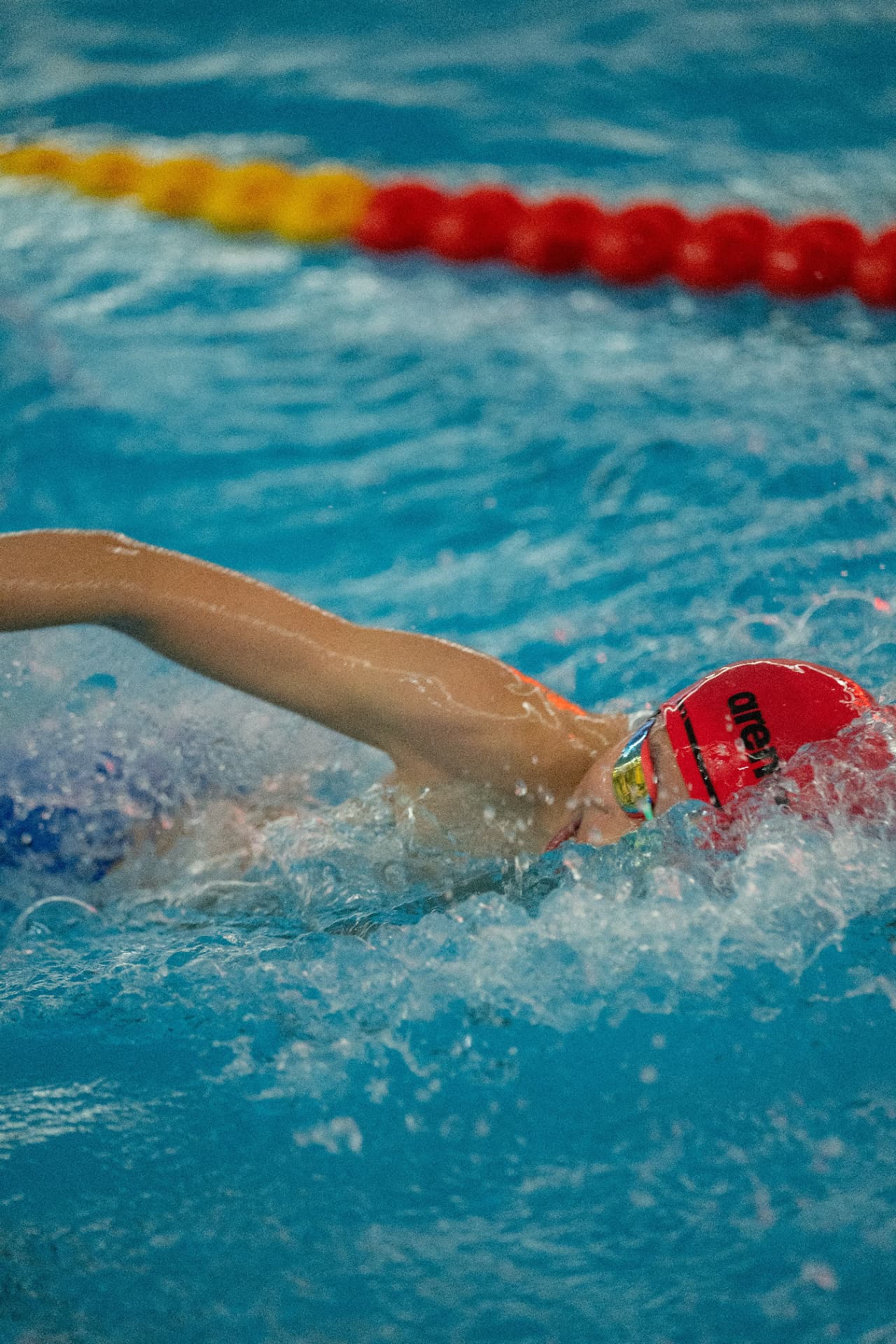
Body Line & Head Position
Body position and alignment · Whole stroke · Research-supported
Technical explanation
A neutral head and level body keep the swimmer's cross-section small. Lifting the head tends to drop the hips and legs.
Biomechanical principles
Form drag increases with the frontal area the body presents to the water. A see-saw effect links head height to hip height.
Why it matters
Lower drag means the same propulsion produces more speed, and less effort is spent holding the legs up.
Proper execution
- Eyes look down and slightly forward
- Back of the head roughly in line with the spine
- Light core engagement to keep hips up
- Kick stays within the body's shadow
Common mistakes & corrections
| Looking forward with the head lifted | Cue eyes to the bottom; use a snorkel or kick-on-side work to feel the level line. |
| Sagging hips and dragging legs | Develop a steady, compact kick and core engagement; check head position first. |
Coaching cues
“Eyes down, hips up” · “Long and tall in the water” · “Swim downhill”
Recommended drills
Body position and balance drills — EST Drill Lab: drills.estperformance.app
Long-Axis Rotation
Hydrodynamics · Entry → Pull · Research-supported
Technical explanation
The shoulders and hips roll together toward each side as the arms alternate. Rotation helps the recovery arm clear the water and positions the pulling arm under the body.
Biomechanical principles
Body roll supports arm recovery, breathing and a stronger pulling position. Research shows shoulders typically roll more than hips, and roll varies by speed and individual.
Why it matters
Good rotation lets larger trunk muscles help the pull and reduces strain on the shoulder.
Proper execution
- Rotate from the core, not only the shoulders
- Head stays still while the body turns
- Roll toward the side of the entering arm
- Return through the midline without pausing flat
Common mistakes & corrections
| Swimming flat | Kick-on-side and 6-kick-switch style work to feel the rotation. |
| Over-rotating onto the back | Keep the opposite hand in front during the breath; aim for a balanced, moderate roll. |
| Head turning with the shoulders every stroke | Fix gaze on the bottom; only turn the head for the breath. |
Coaching cues
“Hip and shoulder move together” · “Roll, don't twist” · “Still head, moving body”
Recommended drills
Rotation and side-balance drills — EST Drill Lab: drills.estperformance.app
References
- Toussaint HM, Beek PJ. Biomechanics of competitive front crawl swimming. Sports Medicine. 1992;13(1):8–24.
- Maglischo EW. Swimming Fastest. Champaign, IL: Human Kinetics; 2003.
- USA Swimming — Technique and coaching education resources.
- Psycharakis SG, Sanders RH. Body roll in swimming: a review. Journal of Sports Sciences. 2010;28(3):229–236.