Resource Builder
Build a Resource
Choose a stroke, focus and level, pick the technical components and sections, reorder them, then save, print or export as a PDF. All content comes from the verified EST Stroke Lab library.
Preview

Stroke Mechanics Guide · Freestyle · Advanced
Freestyle Efficiency: Rate & Length
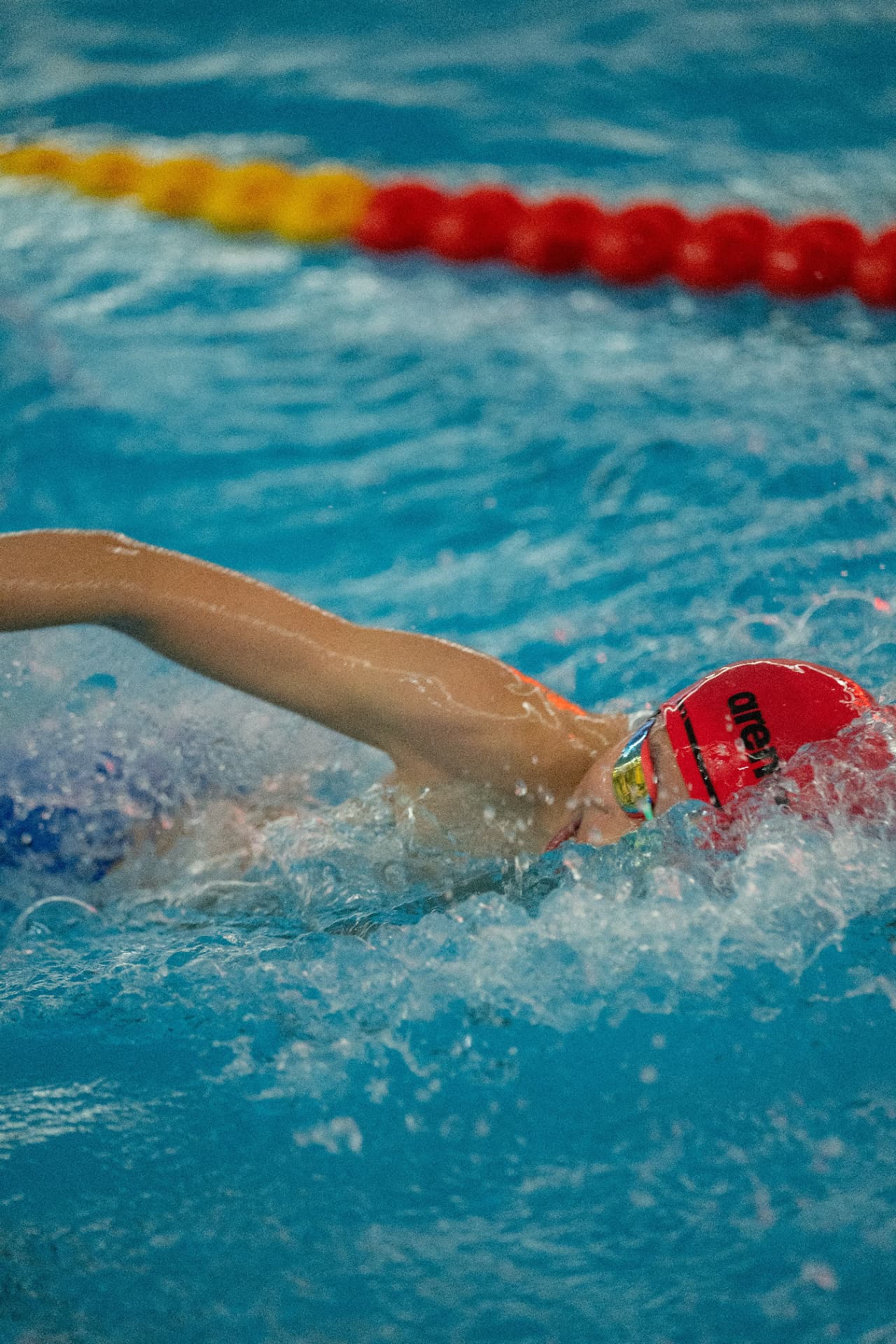
Arm Coordination & Tempo
Stroke rate and distance per stroke · Whole stroke · Research-supported
Technical explanation
How the arms overlap changes with speed: catch-up timing at slow speeds moves toward opposition or superposition when sprinting.
Biomechanical principles
The Index of Coordination (Chollet et al., 2000) quantifies the lag or overlap between arms. Velocity equals stroke rate × distance per stroke.
Why it matters
Matching coordination to the event avoids gaps in propulsion and wasted energy.
Proper execution
- Distance events: slight lead with long extension
- Sprint events: continuous overlap, faster rate
- Keep distance per stroke from collapsing as rate rises
Common mistakes & corrections
| Long glide gaps at race pace | Begin the catch as the other hand passes the head; tempo work. |
| Spinning — high rate, short stroke | Stroke-count sets and rate-controlled swims. |
Coaching cues
“Front quadrant, no dead spot” · “Rate up, length stays”
Recommended drills
Timing and tempo drills — EST Drill Lab: drills.estperformance.app
High-Elbow Catch
Catch mechanics · Catch · Coaching recommendation
Technical explanation
After extension, the fingertips tip down and the elbow stays near the surface so the hand and forearm form one paddle facing backward.
Biomechanical principles
Propulsion depends on the orientation of the hand and forearm relative to the swimming direction. A backward-facing forearm moves water backward more effectively.
Why it matters
An early, well-set catch increases the useful part of each pull and is commonly linked with greater distance per stroke.
Proper execution
- Extend forward, then tip fingertips down
- Elbow stays higher than the hand
- Forearm angles toward vertical before pressing back
- Fingers relaxed, slightly apart is fine
Common mistakes & corrections
| Dropped elbow — pushing water down with the palm | Sculling and single-arm work focusing on elbow position before the pull. |
| Pressing down too early, lifting the head | Pause briefly in extension, then set the catch. |
| Crossing the midline on entry | Enter in front of the shoulder; think 'railway tracks'. |
Coaching cues
“Reach over the barrel” · “Fingertips down, elbow up” · “Hold the water, then move”
Recommended drills
Catch development and sculling drills — EST Drill Lab: drills.estperformance.app
References
- Chollet D, Chalies S, Chatard JC. A new index of coordination for the crawl: description and usefulness. International Journal of Sports Medicine. 2000;21(1):54–59.
- Craig AB, Pendergast DR. Relationships of stroke rate, distance per stroke, and velocity in competitive swimming. Medicine and Science in Sports. 1979;11(3):278–283.
- Barbosa TM, Bragada JA, Reis VM, et al. Energetics and biomechanics as determining factors of swimming performance: updating the state of the art. Journal of Science and Medicine in Sport. 2010;13(2):262–269.
- Maglischo EW. Swimming Fastest. Champaign, IL: Human Kinetics; 2003.
- Toussaint HM, Beek PJ. Biomechanics of competitive front crawl swimming. Sports Medicine. 1992;13(1):8–24.
- GoSwim — Technique and drill education.