Resource Builder
Build a Resource
Choose a stroke, focus and level, pick the technical components and sections, reorder them, then save, print or export as a PDF. All content comes from the verified EST Stroke Lab library.
Preview

Complete Stroke Guide · Breaststroke · Developmental
The Complete Breaststroke Guide
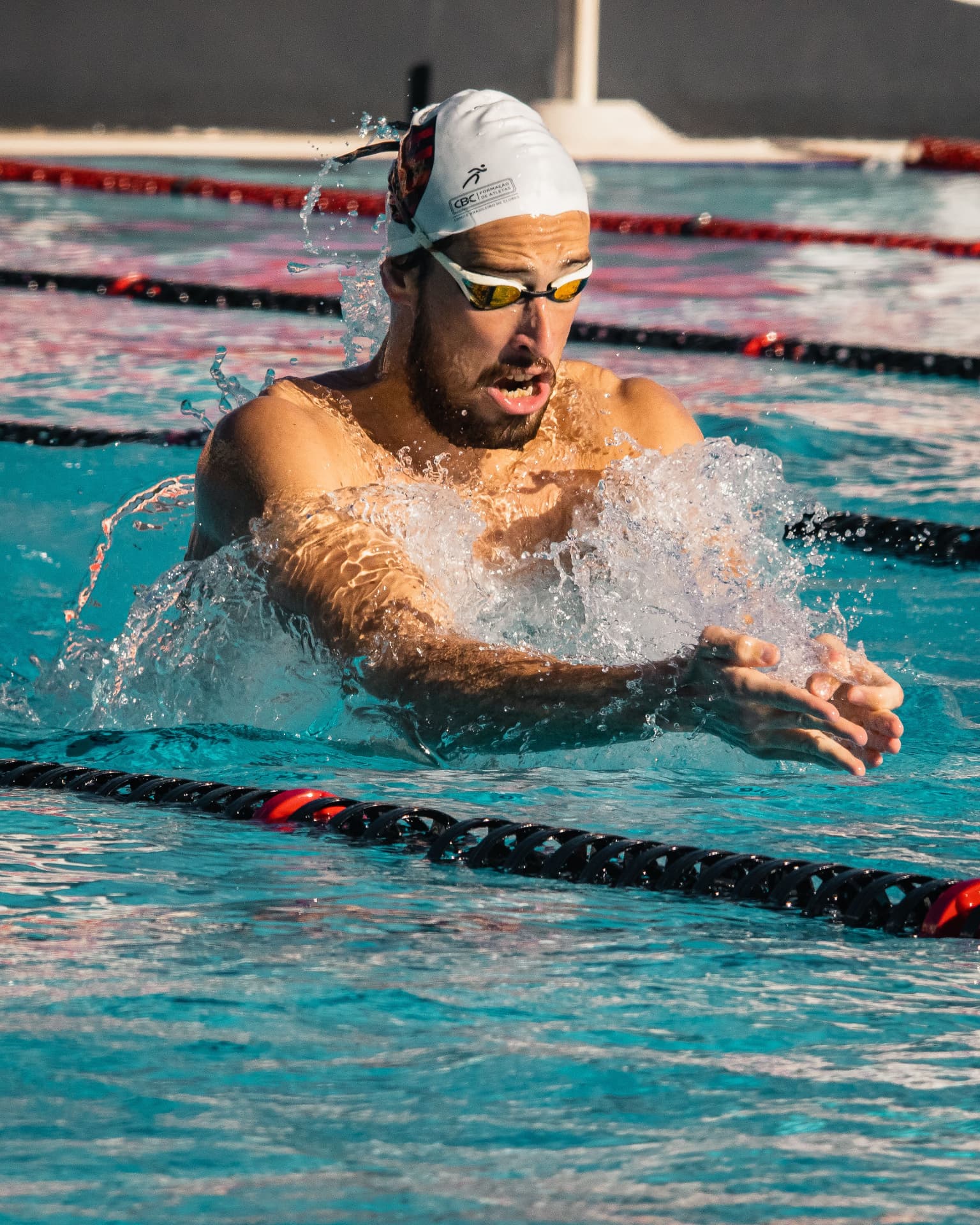
Pull–Breathe–Kick–Glide Timing
Timing and coordination · Whole cycle · Research-supported
Technical explanation
Arms work first, the breath happens at the insweep, legs recover as arms shoot forward, and the kick drives once the arms are extended.
Biomechanical principles
Breaststroke shows the largest intra-cycle velocity variation of the four strokes; overlapping arm and leg recoveries maximises drag and speed loss.
Why it matters
Correct sequencing ensures each propulsive phase acts on a streamlined body.
Proper execution
- Pull starts from streamline
- Breathe as hands sweep in
- Heels recover as hands go forward
- Kick into a long body
Common mistakes & corrections
| Kicking and pulling at the same time | Two-kicks-one-pull and pull-then-kick separated drills. |
| Late arm recovery — kick into open arms | Cue 'hands first, then kick'. |
Coaching cues
“Pull, breathe, kick, glide” · “Arms first, legs second” · “Kick your hands forward”
Indicators of improvement
- ☐ Smooth surge after each kick
- ☐ No stall when the legs recover
Recommended drills
Breaststroke timing and coordination drills — EST Drill Lab: drills.estperformance.app
Whip Kick
Kick mechanics · Recovery → Kick · Research-supported
Technical explanation
Heels draw toward the hips with knees roughly hip-width, feet dorsiflex and turn out, then the inside of the feet and lower legs drive back and together.
Biomechanical principles
The feet and lower legs act as paddles; dorsiflexion and outward rotation present a larger surface backward. Knees drawn too far forward under the body add drag.
Why it matters
The breaststroke kick is a major source of propulsion; small mechanical gains translate into speed.
Proper execution
- Heels up toward the hips, not knees to the chest
- Feet flex and turn out
- Drive back in a rounded path
- Finish with legs together and toes pointed
Common mistakes & corrections
| Knees drawn under the stomach | Kick on back to see knees stay hidden; heels to hips. |
| Screw kick (one foot not turned out) | Wall kicking with slow focus on both feet flexing. |
| Not finishing the kick | Squeeze legs together to full extension before recovery. |
Coaching cues
“Heels to bum” · “Flex, turn, snap” · “Finish together”
Indicators of improvement
- ☐ Distance covered per kick increases
- ☐ Symmetrical foot action
Recommended drills
Breaststroke kick drills — EST Drill Lab: drills.estperformance.app
Outsweep & Insweep
Arm mechanics · Outsweep → Insweep · Coaching recommendation
Technical explanation
Hands sweep outward to just beyond shoulder width, the elbows stay high as forearms catch, then the hands sweep in and up under the chest.
Biomechanical principles
Sculling-type sweeping motions generate force through the hand's pitch; keeping the pull in front of the shoulders avoids long, slow recoveries.
Why it matters
A compact, powerful pull lifts the head for the breath and keeps momentum without excessive drag.
Proper execution
- Sweep out with palms angled outward
- Catch with high elbows
- Accelerate the insweep
- Hands meet under the chest and shoot forward
Common mistakes & corrections
| Pulling past the shoulders to the hips | Keep hands in front of shoulders; 'pull in a small box'. |
| Elbows dropping during the pull | Sculling at the front and high-elbow pull drills. |
Coaching cues
“Small, fast pull” · “Out, in, shoot”
Indicators of improvement
- ☐ Fast hand recovery
- ☐ Shoulders rise without hips sinking
Recommended drills
Breaststroke pull and sculling drills — EST Drill Lab: drills.estperformance.app
Glide & Streamline
Hydrodynamics · Glide · Research-supported
Technical explanation
After the kick, the body holds a long, narrow streamline with head between the arms until speed starts to drop.
Biomechanical principles
During the glide the body decelerates; a tighter streamline reduces drag and slows that loss.
Why it matters
Most breaststroke speed is gained or lost in how efficiently the swimmer holds and leaves the streamline.
Proper execution
- Arms fully extended, hands together
- Head between arms, eyes down
- Legs together, toes pointed
- Start next pull before speed stalls
Common mistakes & corrections
| Head up during the glide | Return the head with the arms; cue eyes down. |
| Gliding too long at race pace | Tempo-controlled cycles matched to event. |
Coaching cues
“Long and narrow” · “Glide, don't stall”
Indicators of improvement
- ☐ Consistent stroke count
- ☐ Less deceleration after the kick
Recommended drills
Streamline and glide drills — EST Drill Lab: drills.estperformance.app
Breathing & Head Line
Breathing mechanics · Insweep · Coaching recommendation
Technical explanation
The shoulders rise with the insweep so the mouth clears; the head stays aligned with the spine and returns with the arm recovery.
Biomechanical principles
Lifting the head independently of the trunk raises frontal area and drops the hips.
Why it matters
A neutral breath keeps the body line and the timing intact.
Proper execution
- Eyes look down and slightly forward
- Rise from the chest
- Quick inhale
- Head returns between arms
Common mistakes & corrections
| Chin lifting high to breathe | Hold a neutral neck; cue 'look at the water just in front'. |
| Late head return | Head and hands go forward together. |
Coaching cues
“Breathe with the shoulders” · “Neutral neck”
Indicators of improvement
- ☐ Hips stay high during breath
- ☐ Smooth return to streamline
Recommended drills
Breathing and head-position drills — EST Drill Lab: drills.estperformance.app
Developmental Development
Technical objectives
- Consistent timing
- Compact pull in front of shoulders
Priorities
- Streamline
- Pull width
Skill progressions
- Two kicks one pull
- Sculling
Technical benchmarks
- ☐ Stroke count stable over repeats
References
- Maglischo EW. Swimming Fastest. Champaign, IL: Human Kinetics; 2003.
- Barbosa TM, Bragada JA, Reis VM, et al. Energetics and biomechanics as determining factors of swimming performance: updating the state of the art. Journal of Science and Medicine in Sport. 2010;13(2):262–269.
- World Aquatics — Swimming rules (stroke legality, underwater limits).
- GoSwim — Technique and drill education.
- U.S. Masters Swimming — Technique articles.