Resource Builder
Build a Resource
Choose a stroke, focus and level, pick the technical components and sections, reorder them, then save, print or export as a PDF. All content comes from the verified EST Stroke Lab library.
Preview

Stroke Mechanics Guide · Backstroke · Foundational
Backstroke Phase Breakdown
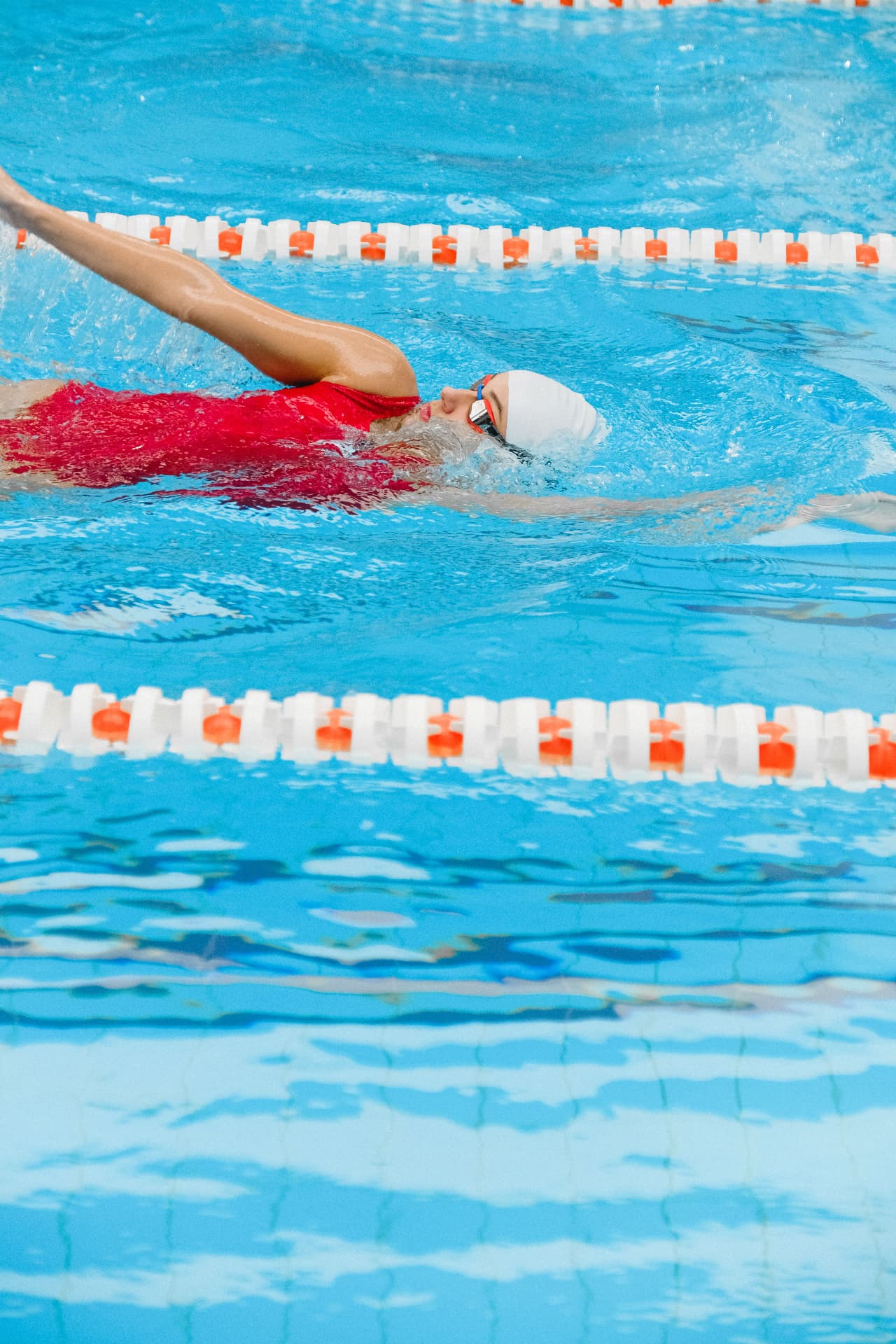
Head Stability & Body Line
Body position and alignment · Whole stroke · Research-supported
Technical explanation
The head stays still with eyes looking up and slightly back; the body rotates beneath it. Hips stay high rather than sitting.
Biomechanical principles
A fixed head acts as the axis for rotation. Raising the head (sitting) increases frontal area and form drag.
Why it matters
A stable axis keeps the stroke straight and the body streamlined.
Proper execution
- Ears near the waterline
- Slight chin tuck, neck relaxed
- Hips and chest high
- Kick keeps legs near surface
Common mistakes & corrections
| Sitting in the water | Push hips up; kick on back with arms by sides focusing on hip height. |
| Head moving side to side | Balance an object or cue a fixed point on the ceiling. |
Coaching cues
“Still head, moving body” · “Hips to the ceiling” · “Chin slightly in”
Recommended drills
Backstroke balance and head-position drills — EST Drill Lab: drills.estperformance.app
Entry & Deep Catch
Catch mechanics · Entry → Catch · Coaching recommendation
Technical explanation
The straight arm enters little finger first around 11 and 1 o'clock, sinks, and the elbow bends to face the palm and forearm backward.
Biomechanical principles
Entering in line with the shoulder protects the joint and positions the hand to catch water at depth where flow is less turbulent.
Why it matters
A clean entry and set catch prevent slipping and make the pull productive.
Proper execution
- Little finger enters first
- Entry in line with shoulder
- Sink hand, then bend elbow
- Palm faces the feet
Common mistakes & corrections
| Crossing behind the head on entry | Aim for 11 and 1 o'clock; single-arm work. |
| Slapping the water flat-handed | Cue little-finger entry and slicing in. |
| Pulling with a straight arm | Bend elbow after the catch; sculling work. |
Coaching cues
“Pinky first” · “Slice, catch, push” · “Elbow bends, palm to feet”
Recommended drills
Catch and single-arm backstroke drills — EST Drill Lab: drills.estperformance.app
Opposition Timing
Timing and coordination · Whole stroke · Research-supported
Technical explanation
One arm enters as the other finishes its push, keeping propulsion continuous with no pause at the thighs.
Biomechanical principles
Continuous opposition limits intra-cycle velocity fluctuation, which reduces the energy needed to re-accelerate the body.
Why it matters
Pausing at the hip creates stop-start speed and costs energy.
Proper execution
- Recovery starts as soon as the push ends
- Arms opposite like a windmill
- Rhythm tied to rotation
Common mistakes & corrections
| Pause at the thigh | Cue continuous windmill tempo; rate-controlled swims. |
| Catch-up timing | Count 'enter–finish' together. |
Coaching cues
“Windmill, no pause” · “One in, one out”
Recommended drills
Timing and tempo drills — EST Drill Lab: drills.estperformance.app
References
- Maglischo EW. Swimming Fastest. Champaign, IL: Human Kinetics; 2003.
- USA Swimming — Technique and coaching education resources.
- GoSwim — Technique and drill education.
- Barbosa TM, Bragada JA, Reis VM, et al. Energetics and biomechanics as determining factors of swimming performance: updating the state of the art. Journal of Science and Medicine in Sport. 2010;13(2):262–269.
- Craig AB, Pendergast DR. Relationships of stroke rate, distance per stroke, and velocity in competitive swimming. Medicine and Science in Sports. 1979;11(3):278–283.