Resource Builder
Build a Resource
Choose a stroke, focus and level, pick the technical components and sections, reorder them, then save, print or export as a PDF. All content comes from the verified EST Stroke Lab library.
Preview

Complete Stroke Guide · Backstroke · Developmental
The Complete Backstroke Guide
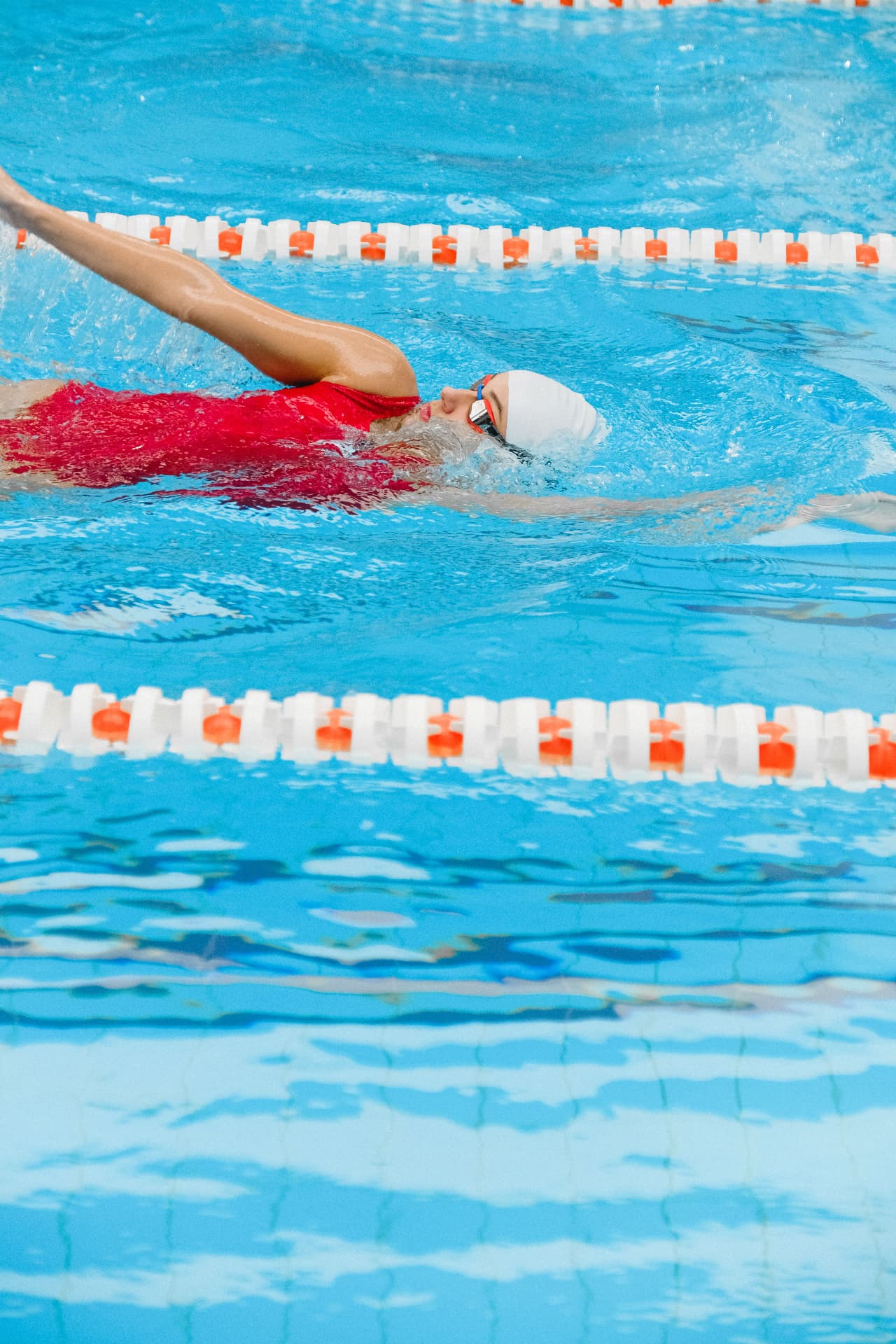
Head Stability & Body Line
Body position and alignment · Whole stroke · Research-supported
Technical explanation
The head stays still with eyes looking up and slightly back; the body rotates beneath it. Hips stay high rather than sitting.
Biomechanical principles
A fixed head acts as the axis for rotation. Raising the head (sitting) increases frontal area and form drag.
Why it matters
A stable axis keeps the stroke straight and the body streamlined.
Proper execution
- Ears near the waterline
- Slight chin tuck, neck relaxed
- Hips and chest high
- Kick keeps legs near surface
Common mistakes & corrections
| Sitting in the water | Push hips up; kick on back with arms by sides focusing on hip height. |
| Head moving side to side | Balance an object or cue a fixed point on the ceiling. |
Coaching cues
“Still head, moving body” · “Hips to the ceiling” · “Chin slightly in”
Indicators of improvement
- ☐ Swims straight without drifting
- ☐ Water line around the ears
- ☐ Hips visible near the surface
Recommended drills
Backstroke balance and head-position drills — EST Drill Lab: drills.estperformance.app
Rotation & Shoulder Drive
Hydrodynamics · Entry → Pull · Research-supported
Technical explanation
The body rolls toward the entering arm, allowing the catch to be set at depth and the recovering shoulder to clear the water.
Biomechanical principles
Body roll in backstroke supports a deeper, more effective pulling position and arm recovery (Psycharakis & Sanders, 2010).
Why it matters
Without rotation the pull stays shallow and the shoulder works in a weaker, more stressful position.
Proper execution
- Roll toward the entering arm
- Recovering shoulder lifts out first
- Hips follow the shoulders
- Head stays fixed
Common mistakes & corrections
| Flat backstroke | Kick on side with shoulder out; 6-kick switch on back. |
| Hips and shoulders out of sync | Cue hips and shoulders turning together. |
Coaching cues
“Shoulder to chin” · “Roll, then pull”
Indicators of improvement
- ☐ Recovery shoulder clears the water
- ☐ Deeper catch without overreaching
Recommended drills
Rotation drills — EST Drill Lab: drills.estperformance.app
Entry & Deep Catch
Catch mechanics · Entry → Catch · Coaching recommendation
Technical explanation
The straight arm enters little finger first around 11 and 1 o'clock, sinks, and the elbow bends to face the palm and forearm backward.
Biomechanical principles
Entering in line with the shoulder protects the joint and positions the hand to catch water at depth where flow is less turbulent.
Why it matters
A clean entry and set catch prevent slipping and make the pull productive.
Proper execution
- Little finger enters first
- Entry in line with shoulder
- Sink hand, then bend elbow
- Palm faces the feet
Common mistakes & corrections
| Crossing behind the head on entry | Aim for 11 and 1 o'clock; single-arm work. |
| Slapping the water flat-handed | Cue little-finger entry and slicing in. |
| Pulling with a straight arm | Bend elbow after the catch; sculling work. |
Coaching cues
“Pinky first” · “Slice, catch, push” · “Elbow bends, palm to feet”
Indicators of improvement
- ☐ Quiet entry with little splash
- ☐ Consistent distance per stroke
Recommended drills
Catch and single-arm backstroke drills — EST Drill Lab: drills.estperformance.app
Backstroke Kick
Kick mechanics · Whole stroke · Research-supported
Technical explanation
A continuous flutter kick from the hip, with the upbeat (toward the surface) providing the main drive; knees stay below the surface.
Biomechanical principles
On the back, the upward kick is the propulsive phase; excessive knee bend increases drag.
Why it matters
A steady kick maintains hip height and balances the alternating arms.
Proper execution
- Kick from the hips
- Knees stay underwater
- Toes break surface lightly
- Pointed, relaxed ankles
Common mistakes & corrections
| Knees breaking the surface (cycling) | Kick with hands above head and straighter legs. |
| Kick stops during arm entry | Kick-focused swim with steady rhythm counts. |
Coaching cues
“Boil the water” · “Knees hidden”
Indicators of improvement
- ☐ Small boil at the surface
- ☐ Hips stay up when arms are still
Recommended drills
Backstroke kick drills — EST Drill Lab: drills.estperformance.app
Opposition Timing
Timing and coordination · Whole stroke · Research-supported
Technical explanation
One arm enters as the other finishes its push, keeping propulsion continuous with no pause at the thighs.
Biomechanical principles
Continuous opposition limits intra-cycle velocity fluctuation, which reduces the energy needed to re-accelerate the body.
Why it matters
Pausing at the hip creates stop-start speed and costs energy.
Proper execution
- Recovery starts as soon as the push ends
- Arms opposite like a windmill
- Rhythm tied to rotation
Common mistakes & corrections
| Pause at the thigh | Cue continuous windmill tempo; rate-controlled swims. |
| Catch-up timing | Count 'enter–finish' together. |
Coaching cues
“Windmill, no pause” · “One in, one out”
Indicators of improvement
- ☐ Smooth, even velocity
- ☐ Stable stroke rate across lengths
Recommended drills
Timing and tempo drills — EST Drill Lab: drills.estperformance.app
Developmental Development
Technical objectives
- Rotation from side to side
- Little-finger entry
- Bent-arm pull
Priorities
- Rotation
- Entry line
Skill progressions
- Kick on side
- 6-kick switch
- Double-arm backstroke
Technical benchmarks
- ☐ Recovery shoulder clears water consistently
References
- Maglischo EW. Swimming Fastest. Champaign, IL: Human Kinetics; 2003.
- USA Swimming — Technique and coaching education resources.
- Psycharakis SG, Sanders RH. Body roll in swimming: a review. Journal of Sports Sciences. 2010;28(3):229–236.
- GoSwim — Technique and drill education.
- Barbosa TM, Bragada JA, Reis VM, et al. Energetics and biomechanics as determining factors of swimming performance: updating the state of the art. Journal of Science and Medicine in Sport. 2010;13(2):262–269.
- Craig AB, Pendergast DR. Relationships of stroke rate, distance per stroke, and velocity in competitive swimming. Medicine and Science in Sports. 1979;11(3):278–283.